The Price of Optionality: Energy, Tariffs, and Chips as Security Policy

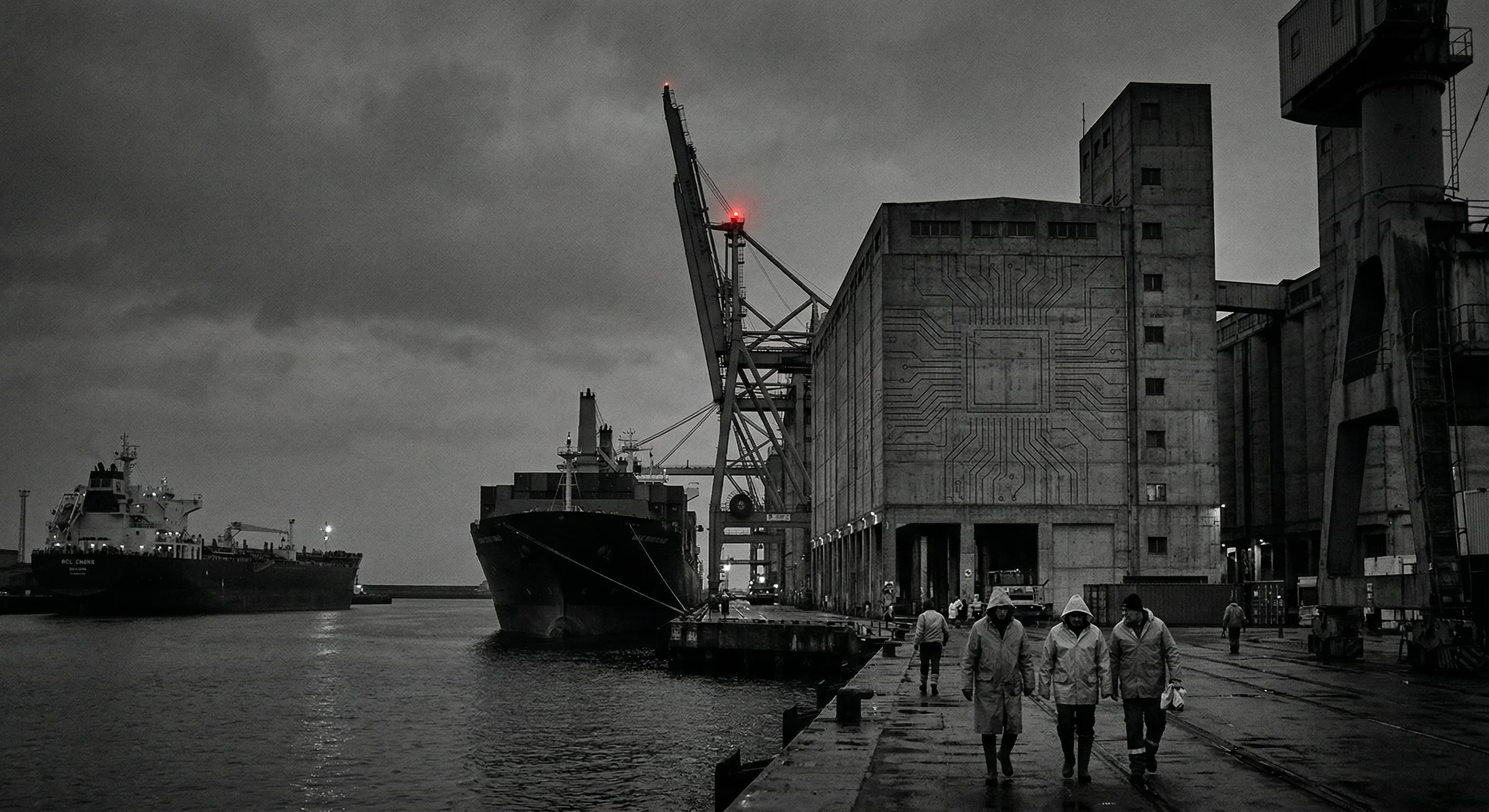
This week’s picture isn’t a single event; it’s a pattern. Risk premium is back—not because of one headline, but because energy, trade, and technology are now treated as national‑security assets. That makes optionality expensive and raises baseline volatility. The global economy is entering a phase where the cost of securing supply chains matters almost as much as the cost of producing.
The core thesis: we’re entering the era of “expensive optionality.” When foreign policy sets freight prices and industrial policy decides who can buy advanced chips, supply shocks return even if demand cools. Margins compress, inflation becomes stickier, and investment turns defensive.
1) Iran: talks without a deal, binary risk
AP reports that the U.S. and Iran ended another day of indirect talks in Geneva without an immediate agreement. Oman described “significant progress,” but Tehran insisted on continuing enrichment and on sanctions relief, while Washington maintains a large military presence in the region. That matters: if diplomacy doesn’t crystallize, escalation risk returns with a direct price tag.
Open‑ended negotiations are perfect for a persistent risk premium. Even without a rupture, markets price the possibility of one. And that premium already leaks through insurance, freight, and energy hedges. The result is oil pricing that rises from precaution, not panic.
2) Energy: freight is a hidden tax
OilPrice notes that VLCC supertanker rates on the Gulf–China route moved above $200,000/day, the highest in six years. The drivers aren’t only Iran tensions: there’s strong Asian demand, shifting flows (India replacing Russian barrels and China increasing Saudi liftings after price cuts), and unprecedented spot‑fleet concentration following Sinokor’s large vessel acquisitions.
This matters because the shock isn’t just the barrel price; it’s the cost of moving it. Higher freight filters into refining spreads, petrochemicals, fertilizers, and transport. When logistics costs rise for geopolitical reasons and due to market concentration, inflation becomes less sensitive to demand. That’s exactly the kind of pressure central banks struggle to cool with a couple of rate cuts.
3) Trade: tariff uncertainty is macro again
Deloitte’s weekly update highlights the legal shift in the U.S.: the Supreme Court ruled IEEPA tariffs unlawful, and the administration responded with a global 10% tariff under Section 122 for 150 days. The message is clear: tariffs are here to stay, but their legal basis and scope are still in flux.
That limbo is the real tax. For firms, uncertainty about tomorrow’s tariff is worse than a high but stable tariff. The result: higher inventories, redundant suppliers, slower capex. Geopolitics shows up in the spreadsheet and raises operational cost of capital.
4) Technology: chips become strategic ammunition
CNBC reports that the House Foreign Affairs Committee advanced legislation giving Congress the power to review and block advanced chip exports to adversarial countries, while freezing existing licenses until the government presents a clear strategy. A parallel proposal would require location‑verification mechanisms in exported chips.
The signal is unambiguous: technology is no longer just a sector; it’s a strategic asset. Nvidia argues that Chinese military reliance on U.S. chips is unlikely, but lawmakers want explicit political control. In practice, this adds regulatory friction and accelerates fragmentation across the AI value chain. Supply becomes more expensive and more local, with pressure on pricing and margins across the stack.
There’s also a capital‑allocation angle: when chips are treated as strategic infrastructure, capacity gets duplicated, subsidized, and geographically constrained. That raises fixed costs and shifts pricing power toward incumbents, while marginal capacity becomes harder to finance. For markets, the AI cycle becomes less about pure demand curves and more about policy calendars—meaning higher volatility and shorter horizons for risk‑taking. That, in turn, makes export policy a first‑order input into valuation models rather than a tail‑risk assumption.
Implications (30–90 days)
-
Stickier inflation via logistics. If freight stays high and Gulf risk persists, the shock hits not only energy prices but cross‑sector input costs.
-
More defensive capex. Firms will prioritize redundancy and resilience over efficiency. ROIC suffers, but production stoppages become less likely.
-
Tech with a regulation premium. Multiples remain exposed while export policy stays under review and subject to sudden shifts.
What to do with this (no theater)
- Investors: favor present cash flows and pricing power. Growth stories with fuzzy margin visibility suffer when optionality costs rise.
- Industrial firms: longer energy contracts, freight hedges, and a real plan‑B for critical inputs. Redundancy is now a competitive edge.
- Policymakers: consistency matters more than level. A temporary but unstable tariff regime is the worst of both worlds.
Bottom line: risk is being repriced because supply shocks are again endogenous. This isn’t a black swan; it’s a redesign of the cost system. And when the cost of moving, trading, and computing rises at the same time, growth becomes a function of strategy—not just demand.
Sources
- AP News — US‑Iran negotiations wrap for the day, no deal (Feb 26, 2026): https://apnews.com/live/us-iran-geneva-nuclear-talks-updates-2-26-2026
- OilPrice — Supertanker market heats up with war premium back in play (Feb 26, 2026): https://oilprice.com/Energy/Energy-General/Supertanker-Market-Heats-Up-With-War-Premium-Back-in-Play.html
- Deloitte — Weekly Global Economic Update (Feb 2026): https://www.deloitte.com/us/en/insights/topics/economy/global-economic-outlook/weekly-update.html
- CNBC — Congress pushes for limits on advanced chip exports to China (Feb 26, 2026): https://www.cnbc.com/2026/02/26/congress-pushes-back-on-nvidia-white-house-with-chip-export-limits.html