Two Wars at Once: The Diplomacy of Words and the Reality of Missiles

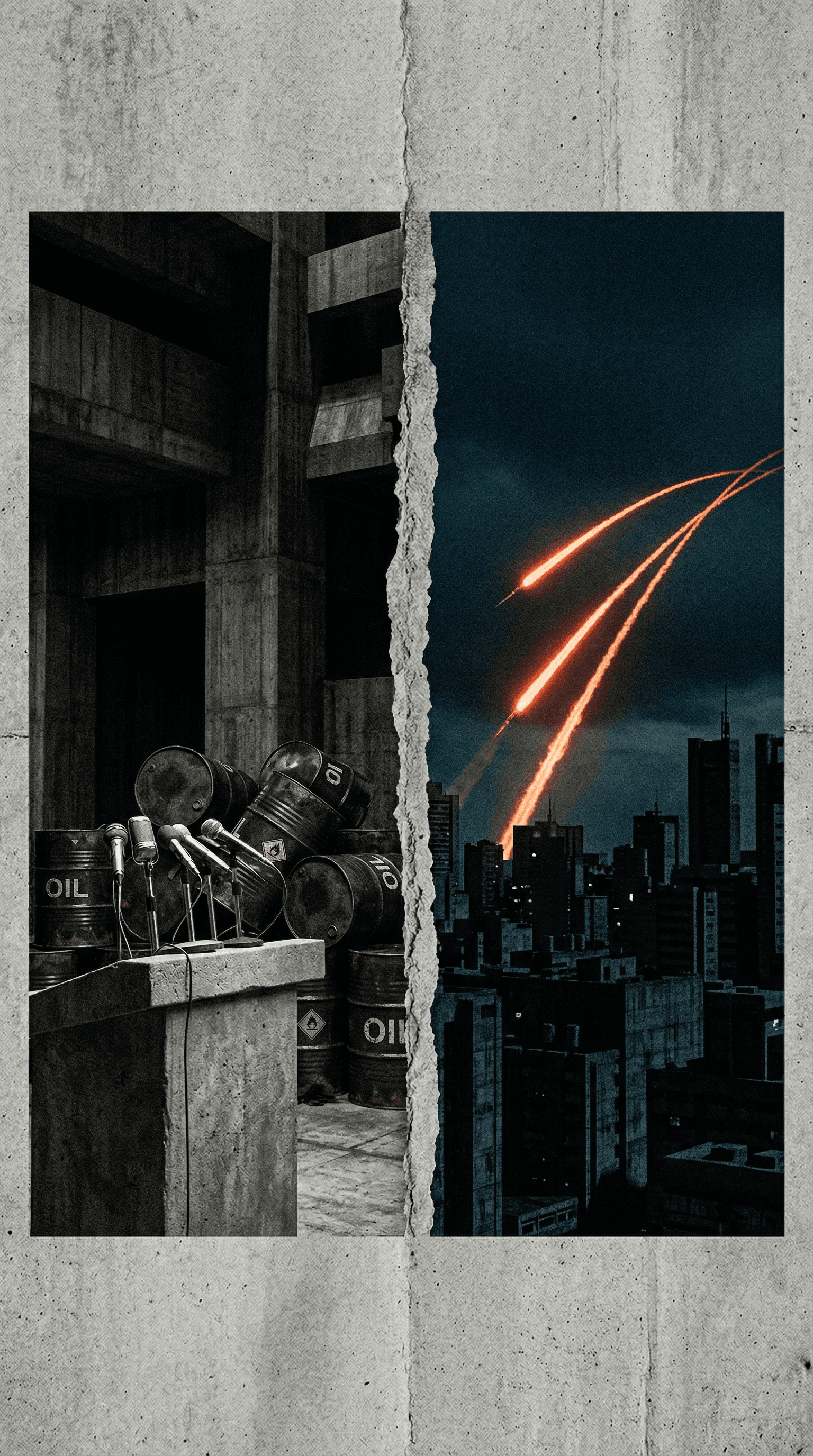
This war is being fought on two simultaneous tracks. The first: an information war where each statement moves Brent crude by several dollars. The second: a kinetic war where missiles keep falling regardless of what anyone says in public.
The problem is that markets are only reading the first track.
Thesis: Trump and Tehran are using words as economic weapons — each trying to move oil prices in the direction that suits them. The divergence between the verbal de-escalation narrative and the operational reality of escalation is the biggest risk signal markets are ignoring.
1. The Word War: Every Tweet Moves $8
On March 23, Trump posted on Truth Social that talks with Iran were "very productive" and he was ordering a five-day pause on strikes against Iranian energy infrastructure. Result: Brent fell nearly 11% — from $100 to $88 — in a single session. The largest single-day move since the conflict began.
Trump's interest is clear: domestic inflation is the only number that threatens his political standing. His statements about "productive conversations" and "last chance for peace" don't need to be true to do their job. They work if markets believe them.
Iran's response came immediately. The military command called Trump's version "fantasy." Result: Brent recovered part of the drop. Iran also has an inverted interest: it needs expensive oil to finance the conflict. Its denials are equally instrumental.
The New York Times diagnosis is precise: talks "are in an early stage and not substantive." A European official was more direct: there have been "no direct negotiations between the two nations." What exists are messages relayed through Egypt, Pakistan, and Gulf states.
2. The Real War: Iran Strikes Central Israel While "Negotiating"
Parallel to this semantic battle, the kinetic war has escalated this week. Iran struck central Israel — not the south, not the periphery. Attacks on Gulf infrastructure continue. Qatar's Ras Laffan LNG hub was struck by Iranian missiles on March 19.
None of this is coherent with a party negotiating an exit. Iran's actions point to a different strategy: hold on, inflict damage, and wait for domestic pressure in the U.S. to force Trump to back down.
This divergence — verbal de-escalation, operational escalation — is the classic pattern of an actor trying to buy time without ceding ground. And it's exactly what markets tend to overlook when a single tweet produces a $12 move in crude.
3. The Clock: 72 Hours Until the Pause Expires
The five-day pause expires March 28. As of today, Iran has made no gesture toward Hormuz. The strait remains at roughly 5% of normal capacity. Goldman's warning stands: if flows stay this low for ten weeks from the initial closure (March 4), Brent exceeds its 2008 all-time high of $147 per barrel. That window closes in 49 days.
Trump's March 28 dilemma is real. Following through on his threat to strike Iranian power plants risks full escalation. Not following through signals that his threats are empty. Both options carry cost. The difference is that the first option's cost is paid by the entire world.
Implications
For energy markets: the operational range this week is $90–115. Oil responds to statements, but the floor is real infrastructure — which hasn't changed. The tail risk of $130+ within 48 hours if March 28 brings escalation is not priced in.
For Europe: the ECB froze rates at 2% on March 19. Its baseline puts 2026 inflation at 2.6%; the prolonged energy shock scenario pushes it to 3.5–4.4%. With European natural gas prices doubled and UK inflation heading toward 5%, the margin for error is essentially zero.
For the geopolitical read: when one party escalates in the field and de-escalates at the microphone simultaneously, the correct signal is not the microphone. The bond market — which hasn't bounced on any of the "good news" — is reading this more accurately than equities.
Close
Trump is right about one thing: March 28 is a "last chance." Just not the opportunity he's describing. It's the last chance for markets to reprice before reality does it for them.