Three Weeks at Hormuz: The Energy Trap No One Can Defuse

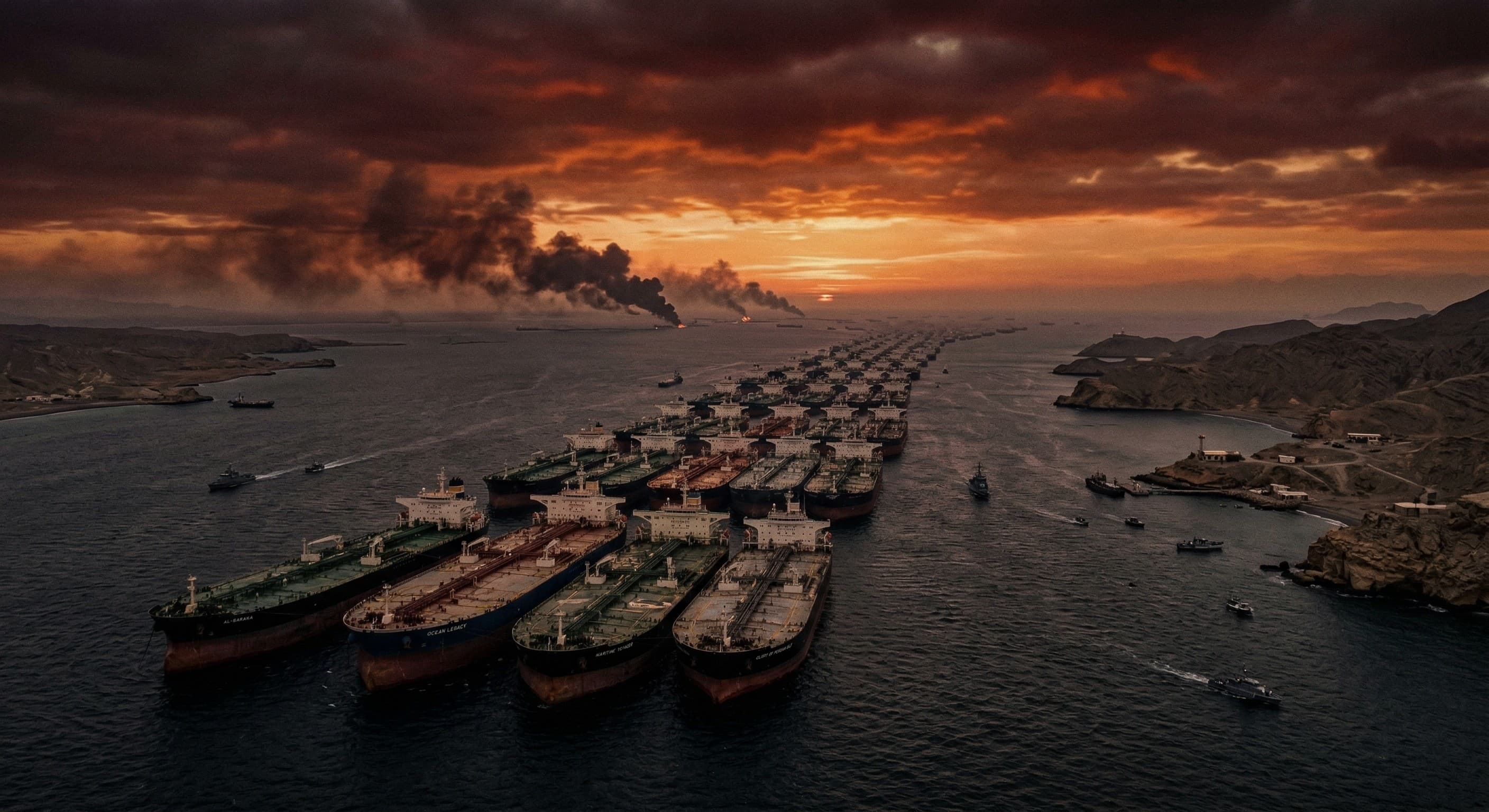
On February 28, Operation Epic Fury — coordinated US-Israeli strikes on Iranian military and leadership infrastructure — shattered three decades of tense equilibrium in the Persian Gulf. Three weeks later, the Strait of Hormuz remains a militarized chokepoint and the global economy is absorbing the hit. No clear exit strategy is in sight.
Thesis: the effective closure of Hormuz is the most severe energy supply shock since 1973 — and it's generating a policy trap that no central bank can easily escape.
1) The closure that was supposed to be brief… isn't
Hormuz is the 33-kilometer passage through which 20% of the world's oil and LNG flows. Before February 28, Brent crude traded around $75. Within days it jumped to $110 and touched intraday highs of $126. This is the largest supply disruption in petroleum market history: combined output from Kuwait, Iraq, Saudi Arabia, and the UAE dropped by at least 10 million barrels per day by March 12.
Alternative routes offer no quick fix. Commercial vessels are once again rerouting via the Cape of Good Hope, adding weeks to each voyage. The Suez Canal and Bab-el-Mandeb strait are also being avoided due to Houthi risk. Shipping costs have spiked and global logistics are fraying in ways not seen since the worst days of the pandemic.
2) The Fed, cornered
The Federal Reserve had planned to cut rates in 2026. That's off the table. The FOMC meeting on March 17-18 ended with no change: the fed funds rate stays in the 3.5%–3.75% range. The problem isn't indecision — it's a structural trap.
On one side, the US labor market lost 92,000 jobs in February — a recessionary signal. On the other, core PCE — the Fed's preferred inflation gauge — rose 3.1% year-over-year in January and is not retreating. The energy shock adds cost-push inflation without any demand overhang. The Fed's playbook has no page for this.
Goldman Sachs and JPMorgan have abandoned their spring and summer cut forecasts. The most optimistic scenario they now model is a single cut in December, if the conflict de-escalates before then.
3) Europe, again on the edge
The 2025-2026 winter left European gas storage lower than usual. The Hormuz closure hits at the worst moment: the LNG that transited through the strait — part of the supply Europe needed to refill reserves before next winter — is now scarce and expensive. Flights between Africa, Asia and Europe have been forced to reroute around closed Middle Eastern airspace. Tourism in the eastern Mediterranean — Turkey, Greece — is also taking a hit.
The European Council has already convened emergency energy sessions. The irony was noted by Council President António Costa himself: the only actor benefiting is Russia, whose oil revenues surge with every dollar added to the barrel.
Implications
- The energy risk premium is not transitory. While Hormuz stays closed or contested, oil doesn't come down. That feeds structural, not cyclical, inflation.
- Central banks cannot fix this. Raising rates slows the economy but doesn't produce oil. Cutting rates fans inflation. Monetary policy is powerless against a pure geopolitical supply shock.
- China watches and buys. Beijing has kept rates steady and is absorbing discounted crude from alternative producers. Every week that passes, its relative position strengthens.
- Stagflation risk is no longer theoretical. Persistent inflation + rising unemployment + stalled growth = the scenario the 1970s left as a warning.
Close: three weeks at Hormuz have turned a regional conflict into a first-order global macroeconomic variable. The shock is not temporary until the strait reopens. And nobody knows when that will be.