The Hormuz Clock: Expensive Oil and the Tariff Reboot

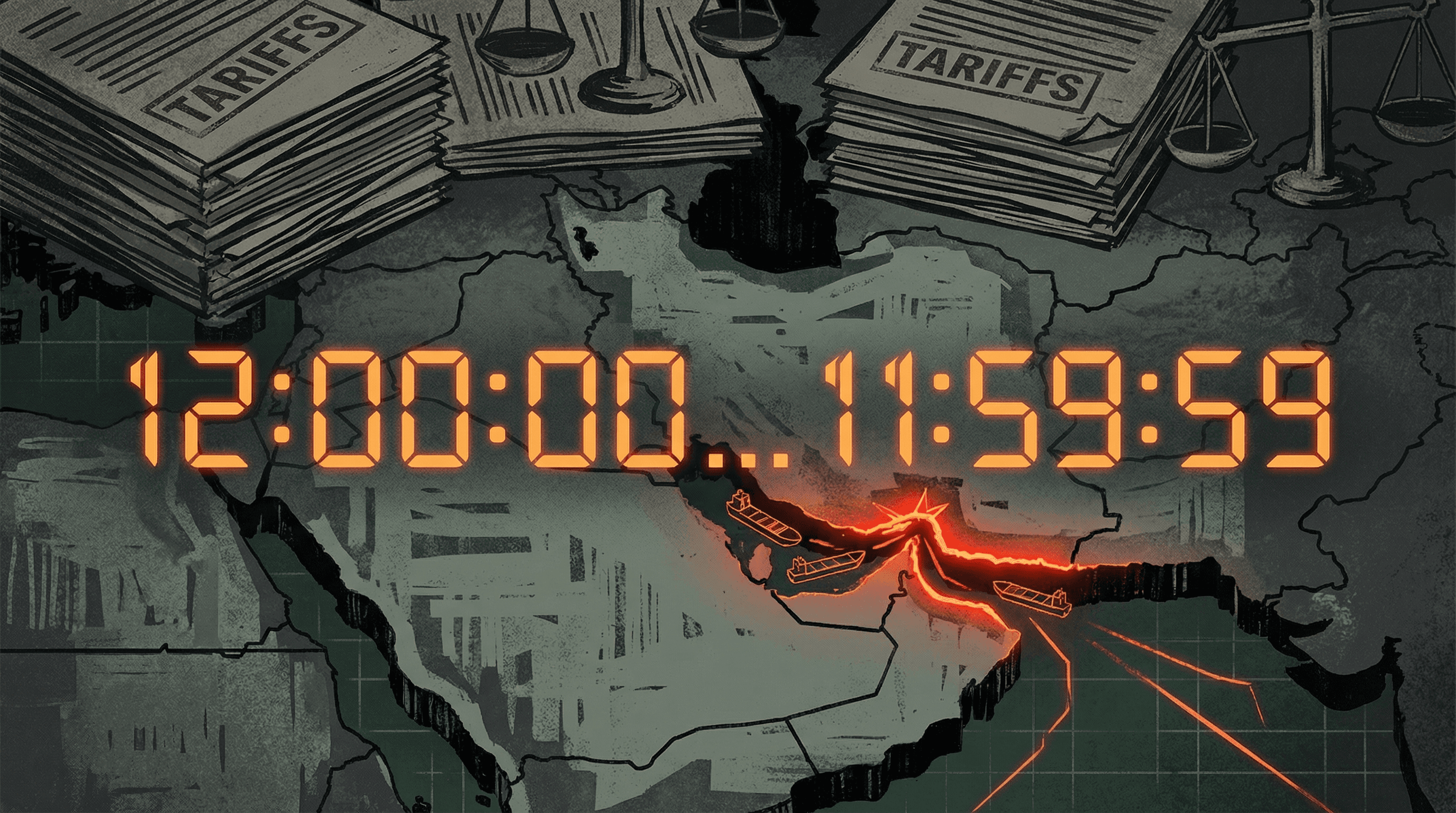
Brent is sitting around $112. The Strait of Hormuz remains under threat. And Trump's trade war is being rebuilt on sturdier legal footing after the Supreme Court killed IEEPA tariffs in February. Two shocks, both escalating.
Thesis: The Iran war and the Section 301 tariff reboot are the twin pressures defining global macro in Q2 2026.
1) The Hormuz Clock: Two Weeks to Avoid Structural Damage
Crude surged nearly 9% last week. Brent hit a peak of $126 on March 8 when Iran closed the strait, cutting 20% of global oil supply and significant LNG volumes. It has since pulled back to the $111-112 range, with WTI around $99.
Why the pullback? Markets are still pricing in a swift resolution. Diplomatic signals from Washington and a partial sanctions lift gave a brief reprieve. But analysts cited by CNBC are blunt: if Hormuz stays compromised for two more weeks, the damage stops being temporary. Alternative shipping costs, insurance premiums and route diversions become structural. The IEA called this "the greatest global energy security challenge in history."
2) Section 301: The Trade War Reboots from Scratch
On February 20, the Supreme Court struck down IEEPA tariffs in a 6-3 ruling. Trump's response came the same day: a 10% global tariff under Section 122 of the Trade Act of 1974 (valid for 150 days). The day after, the USTR announced Section 301 investigations against more than 60 countries — China, Mexico, Vietnam, the EU, Japan, Taiwan and more.
The difference from IEEPA matters: Section 301 has no cap on tariff rates and no time limit. Investigations take 12-18 months, but the first Trump term showed exactly how that window gets used — to build a legal case, then apply aggressive rates. The effective average tariff already hit 7.7% in 2025, the highest since 1947. The new tariff floor stays high.
3) China in the Crossfire: Deflation Meets Energy Shock
China has spent months in a deflationary spiral: excess capacity, weak domestic demand, negative producer prices. The Iran conflict introduces a new variable: expensive imported energy. Reuters frames it as the risk of flipping China's deflation into "bad inflation" — costs rising through the energy channel while consumption stays depressed.
That's the worst scenario for Beijing: it can't stimulate too aggressively (imported inflation risk) and can't ignore the shock (industrial damage). On top of that, the coming Section 301 tariffs threaten its main escape valve — exports.
Implications
- Oil won't return to $70 this year. Even if Hormuz reopens, the geopolitical premium is now priced in. Markets are repricing long-term supply risk.
- Tariff uncertainty runs 12-18 months. Section 301 investigations don't resolve quickly. Companies can't plan supply chains without knowing the final rate.
- Central banks are boxed in. The ECB held rates last week but its own base case already projects 2.6% inflation for 2026. Cutting rates feeds inflation; raising them deepens the slowdown.
- S&P Global cuts global growth forecasts. The risk isn't deep recession — but growth near zero in Europe and well below trend in the US.
Close: Two shocks, one clock. Markets are still betting that Hormuz resolves and Section 301 gets negotiated away. They may be right. But if they're wrong on either front, the cost of the error won't be symmetric.