One Year Since Liberation Day

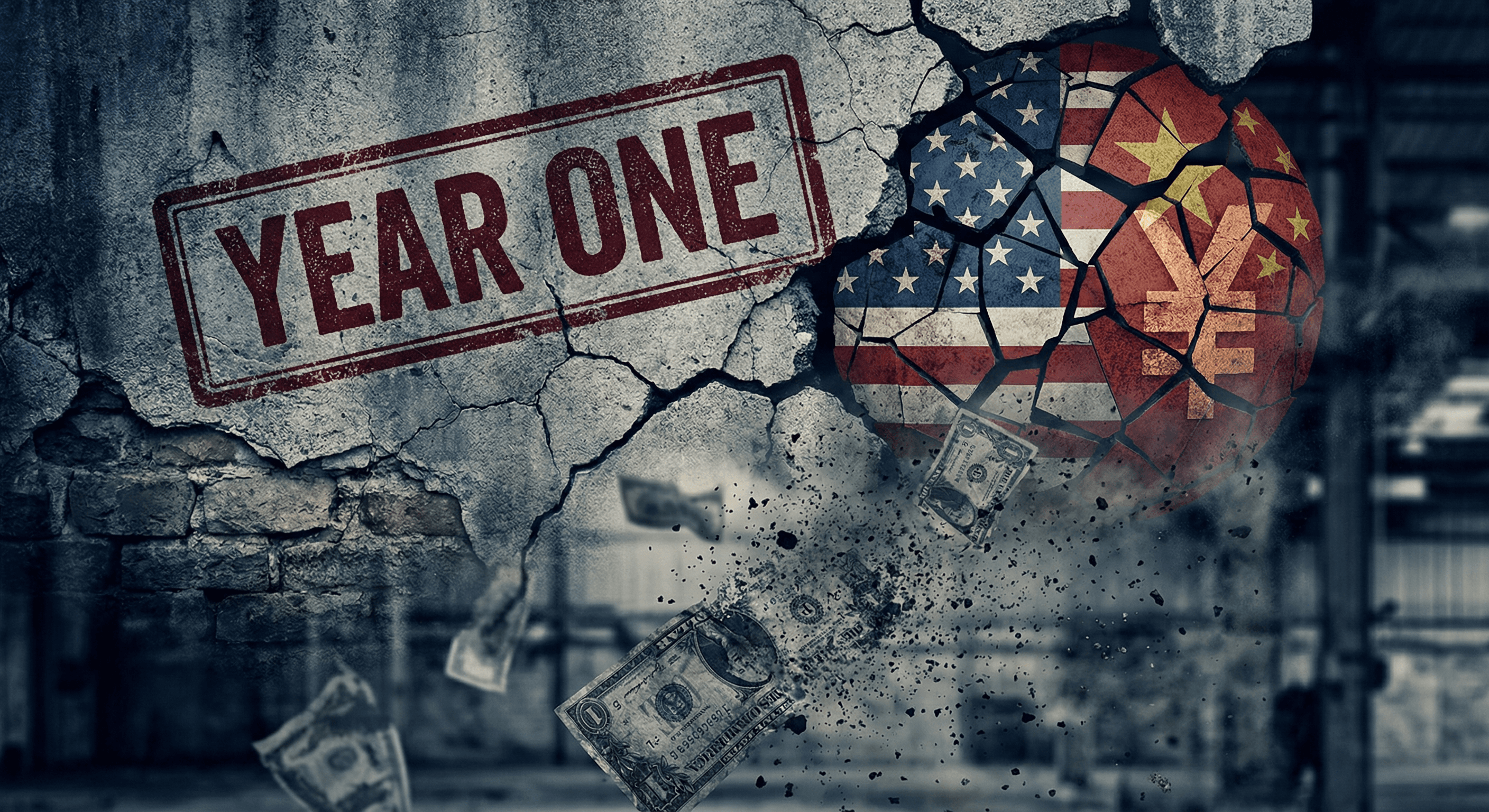
On April 2, 2025, Trump walked onto a White House stage with a "Liberation Day" backdrop and announced the end of America's commercial exploitation. Universal 10% reciprocal tariffs, differentials up to 125% on China, all invoked under IEEPA emergency powers. One year later, the Supreme Court struck them down as unconstitutional, the trade deficit grew, and consumers paid the tab.
Thesis: Trump's tariff revolution failed on every declared metric — but the fractures it opened in the multilateral trade order and in dollar dominance are real, cumulative, and hard to reverse.
1. The numbers: the experiment failed its own benchmarks
In February 2026, the Supreme Court ruled the IEEPA tariffs unconstitutional — the first time that emergency law had ever been used to impose tariffs in US history. The accounting blow is enormous: in 2025, customs collected $264 billion (versus $79 billion in 2024). Most of it will need to be refunded.
The average effective tariff rate climbed to 7.7% — the highest since 1947. Real consumer cost: +2% on consumer goods, roughly $1,000 per US household. Around 90–95 cents of every tariff dollar was passed through to end prices. Manufacturing, rather than rebounding, shed 100,000 jobs. The trade deficit — the central policy target — grew instead of shrinking.
2. The WTO: structural damage without a referee
This week, WTO talks ended in deadlock after Brazil blocked a US proposal. This is not an isolated incident — it's a pattern. The multilateral trade body built between 1944 and 1995 has no recovery mechanism when the anchor power actively walks away from it.
Rules-based free trade was a deliberate postwar architecture. It doesn't rebuild itself by inertia.
3. The deeper fracture: the petrodollar under pressure
The sharpest analysis this week comes from Deutsche Bank: the US war against Iran is exposing cracks in the petrodollar system. The 1974 deal with Saudi Arabia — oil priced in dollars in exchange for American security in the Gulf — works while the US can keep the Strait of Hormuz open. Iran can still selectively close it, and some countries are already negotiating passage by paying in yuan.
Saudi Arabia has joined mBridge, China's central bank digital currency project. Sanctions on Russia and Iran normalized energy trade in alternative currencies. Deutsche Bank put it plainly: "The world saves in dollars in large part because it pays in dollars." If that chain breaks, the dollar's structural advantage disappears.
Implications
Refund chaos: unwinding $264 billion in unconstitutional tariff collections is an unprecedented legal process. Affected companies will wait months — possibly years — with accounting uncertainty in the interim.
China gains by default: the Financial Times published this week "A Blueprint for Chinese Global Leadership: the opportunity is Beijing's for the taking." Not Chinese propaganda — markets mapping the vacuum the US left in global trade governance.
The dollar as store of value depends on the dollar as a security currency: that's the central macro bet of the next cycle. As long as US power projection in the Gulf is questionable, the petroyuan has structural tailwinds.
Close
One year later, Liberation Day liberated something — just not what was promised. It freed up space for others to fill. And that space, once occupied, isn't recovered by executive order.